NATO, UKRAINE
NATO’s €70 Billion Ukraine Commitment: Legal Risks, Compliance and Defence-Industrial Strategy
NATO’s €70 billion commitment to Ukraine creates not only a defence-industrial opportunity, but also a complex legal and regulatory challenge. This analysis examines the procurement, export-control, sanctions, anti-corruption, State aid, cybersecurity, AI governance and end-use risks that governments and defence companies must manage as political commitments turn into contracts, production and delivery.
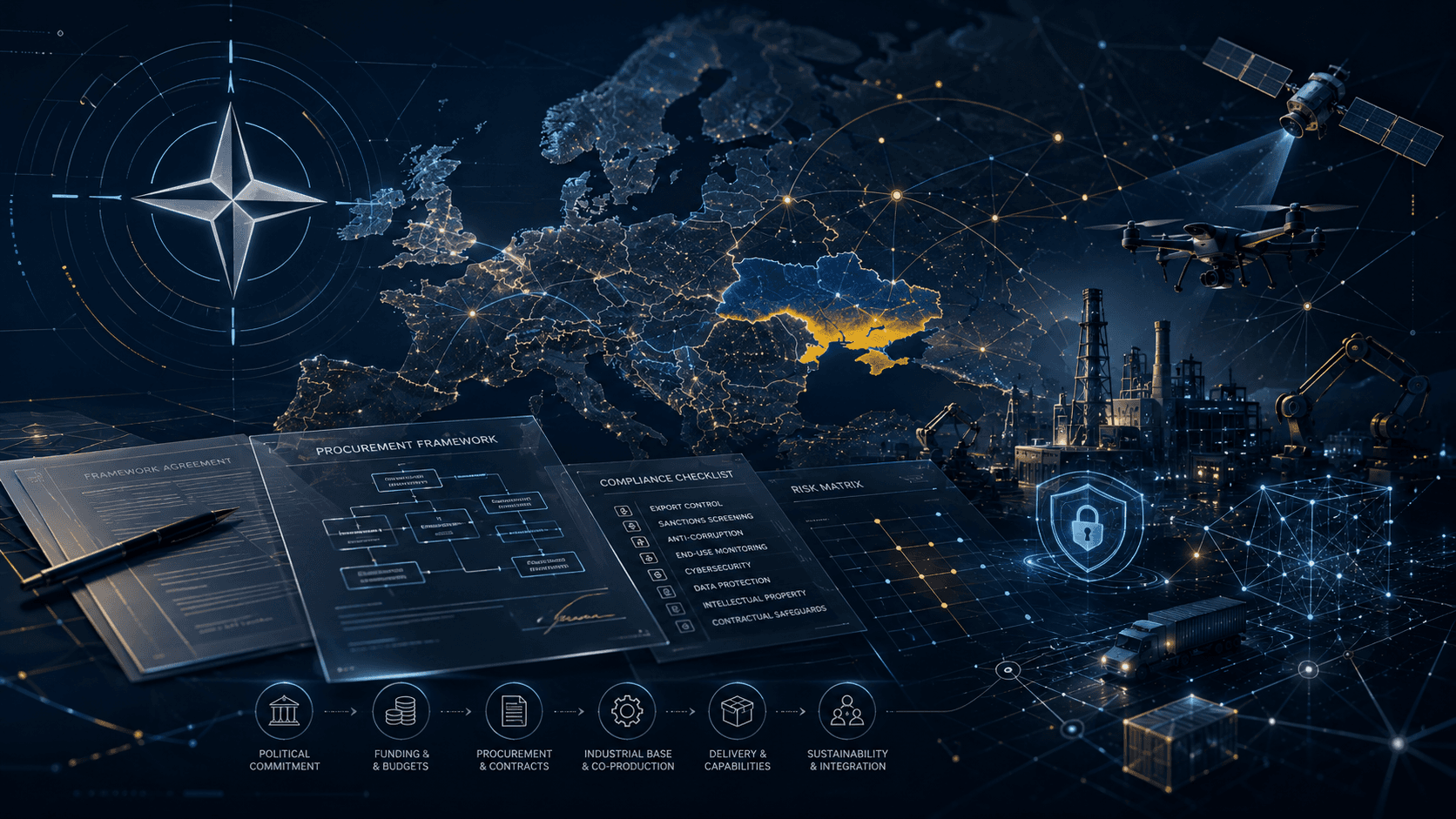
A Legal Risk and Compliance Analysis for Defence Industry, Technology Companies and Public-Sector Decision-Makers
Reviewed by Oleksandr Sobovyi, Founder & CEO of CORVUS AI — editorial responsibility statement below.
Executive Summary
NATO’s pledge to provide Ukraine with €70 billion in military equipment, assistance and training in 2026 is not merely a political declaration. It is a strategic signal with direct legal, industrial and commercial consequences.
The Ankara Summit Declaration states that Allies pledge €70 billion in military equipment, assistance and training for Ukraine in 2026 and affirm sovereign commitments to sustain at least equivalent levels in 2027. NATO also links this support to long-term predictability and sustainability, including European funding mechanisms for Ukraine.
For governments, this creates a delivery challenge: how to convert political commitments into legally defensible procurement, export-control, financing and oversight mechanisms. For industry, it creates a major opportunity across ammunition, air defence, drones, counter-UAS, C4ISR, cybersecurity, AI-enabled systems, logistics, maintenance, repair, training and joint production.
However, the opportunity is legally complex. Companies entering Ukraine-related defence supply chains must manage not only procurement law, but also export control, sanctions, anti-corruption compliance, classified information, State aid, end-use monitoring, cybersecurity, data protection, AI governance, intellectual property and supply-chain security.
The central point is clear: the winners in this new defence-industrial environment will not simply be the companies that move fastest. They will be the companies that can prove legal reliability, regulatory discipline, security of supply and operational credibility.
1. Legal Nature of NATO’s €70 Billion Commitment
The €70 billion commitment should not be understood as a single centralised NATO procurement contract.
NATO is an intergovernmental defence alliance. Its political decisions create strategic alignment, but implementation usually occurs through national budgets, bilateral agreements, multilateral coalitions, NATO agencies, EU instruments, direct government contracts and subcontracting structures.
In legal terms, the commitment is best understood as a political and sovereign commitment by Allies, rather than a directly enforceable commercial obligation against NATO as an institution.
This distinction matters.
For industry, contractual rights will arise only through specific legal instruments, such as:
national defence procurement procedures;
framework agreements;
intergovernmental arrangements;
NATO Support and Procurement Agency mechanisms;
EU defence-industrial programmes;
bilateral contracts with ministries of defence;
contracts with Ukrainian authorities or defence enterprises;
prime contractor and subcontractor arrangements.
The Ankara Declaration expressly refers to sovereign commitments by Allies. This means that budgetary approval, procurement procedure, export licensing, parliamentary oversight and contract execution remain primarily matters of national law and national responsibility.
The practical implication is important: companies should not build their market strategy around “NATO as the buyer” alone. The actual opportunity will sit at the intersection of NATO priorities, EU defence-industrial policy, national ministries of defence, Ukrainian institutions, multilateral procurement coalitions and prime contractors.
2. Strategic Context: From Emergency Support to Industrial Architecture
The Ukraine support model is evolving.
In the first phase of the war, assistance was heavily shaped by emergency donations, stock transfers and urgent bilateral packages. The €70 billion commitment signals a more structured phase: predictable funding, longer-term production planning, joint procurement, industrial ramp-up, co-production and integration of Ukraine into the Euro-Atlantic defence-industrial base.
NATO has separately emphasised the importance of strengthening defence industry production, increasing ammunition output, improving supply-chain resilience and converting defence investment commitments into real capabilities.
This creates demand not only for finished military equipment, but also for:
ammunition and artillery systems;
air and missile defence;
drones and autonomous systems;
counter-drone technologies;
electronic warfare;
secure communications;
battlefield management systems;
intelligence, surveillance and reconnaissance;
cyber defence;
satellite-enabled services;
repair and maintenance;
training and simulation;
logistics;
component manufacturing;
AI-enabled decision-support and targeting-support systems.
The legal consequence is that defence supply chains will become more international, more technology-intensive and more compliance-sensitive.
3. Applicable Legal Framework
3.1 NATO Framework
Relevant NATO instruments and standards may include:
the Ankara Summit Declaration;
decisions of the North Atlantic Council;
NATO capability targets;
NATO standardisation agreements, including STANAGs;
NATO Support and Procurement Agency mechanisms;
interoperability requirements;
security-of-supply policies;
classified information handling requirements;
multinational procurement and co-production initiatives.
NATO’s public materials indicate a clear policy direction: accelerating defence production, strengthening the transatlantic defence-industrial base and supporting Ukraine’s defence-industrial capacity.
3.2 European Union Framework
For companies and governments located in EU Member States, the legal framework will also include EU law.
Key instruments include:
Directive 2009/81/EC on defence and security procurement;
Directive 2014/24/EU where ordinary public procurement rules apply;
Article 346 TFEU on essential security interests;
Regulation 2021/821 on dual-use export controls;
Common Position 2008/944/CFSP on arms exports;
EU sanctions against Russia and Belarus;
GDPR;
NIS2 Directive;
Cyber Resilience Act;
AI Act, where relevant;
EU State aid rules;
Foreign Subsidies Regulation;
EU Financial Regulation where EU funds are involved;
European Defence Industrial Programme;
Ukraine Support Instrument;
other EU defence-industrial and joint procurement instruments.
The European Commission states that the European Defence Industrial Programme includes a Ukraine Support Instrument with a dedicated budget of €300 million to support the recovery, reconstruction and modernisation of Ukraine’s Defence Technological and Industrial Base, with a view to possible future integration into the European defence technological and industrial base.
The Council of the EU also describes the Ukraine Support Instrument as a mechanism supporting Ukraine’s defence industry, including cooperative procurement with Ukraine and the ramp-up of defence manufacturing capacities of Ukrainian companies.
3.3 Ukrainian Legal Framework
Where contracts are concluded with Ukrainian authorities or Ukrainian defence enterprises, additional legal issues arise under Ukrainian law, including:
public procurement and defence procurement rules;
martial-law procurement procedures;
import and export licensing;
military end-use control;
currency control;
anti-corruption legislation;
state secrecy rules;
public-private cooperation rules;
intellectual property protection;
rules on localisation, joint production and technology transfer.
Companies should treat Ukraine-related defence projects as legally multi-layered transactions, not ordinary cross-border sales.
4. Main Legal Risks for Industry
4.1 Public Procurement Risk
The first risk is procurement law.
The existence of a political commitment does not eliminate procurement obligations. Even urgent defence procurement must be legally justified. Public authorities may rely on urgency, national security exemptions or negotiated procedures, but these choices must be supported by a defensible legal record.
Risks include:
unlawful direct awards;
insufficient justification of urgency;
weak competition analysis;
conflict of interest;
discriminatory technical specifications;
lack of audit trail;
procurement challenges by competitors;
later review by audit authorities or parliamentary committees.
For suppliers, this means that a contract awarded quickly may still be vulnerable if the public authority cannot defend the procedure.
Recommended approach: companies should prepare a procurement defence file containing evidence of military urgency, interoperability needs, security of supply, unique technical capability, lifecycle cost and delivery constraints.
4.2 Export Control and End-Use Risk
Most defence and dual-use supplies to Ukraine will require export-control analysis.
Key questions include:
Is the product a military item?
Is it a dual-use item?
Does the transaction involve technical assistance?
Are software, firmware, source code or technical documentation controlled?
Is an export licence required?
Are US-origin components subject to ITAR or EAR?
Is re-export permitted?
Who is the final end user?
Can the equipment be transferred to third parties?
How is end-use monitored?
Failure to comply with export-control rules can result in criminal liability, licence revocation, exclusion from future defence contracts, reputational harm and sanctions exposure.
Recommended approach: companies should establish a dedicated Ukraine Export Control Protocol covering product classification, licensing, routing, end-user verification, re-export controls, technical assistance and post-delivery restrictions.
4.3 Sanctions Risk
Ukraine-related defence transactions require enhanced sanctions screening.
Screening should cover:
suppliers;
subcontractors;
logistics providers;
banks;
insurers;
beneficial owners;
consultants;
agents;
distributors;
cloud and software providers;
end users;
transit jurisdictions.
The key risk is hidden exposure to sanctioned Russian, Belarusian or affiliated actors through third countries, shell companies, informal intermediaries or opaque supply chains.
Recommended approach: companies should apply enhanced due diligence to every Ukraine-related defence transaction, including beneficial ownership checks, sanctions warranties, audit rights, termination rights and transaction monitoring.
4.4 Anti-Corruption Risk
Defence procurement during wartime is a high-risk environment.
The risk is not limited to Ukraine. Donor governments, contractors, subcontractors, consultants and intermediaries are all exposed to anti-corruption scrutiny.
Typical red flags include:
politically connected intermediaries;
unexplained success fees;
inflated pricing;
opaque logistics costs;
emergency procurement without documentation;
side letters;
undisclosed subcontractors;
gifts and hospitality;
conflicts of interest;
unjustified sole-source awards;
payments to offshore entities.
Recommended approach: companies should apply defence-grade anti-bribery and corruption controls, including intermediary due diligence, approval matrices, gifts and hospitality controls, whistleblowing channels, audit rights and strict prohibition of unauthorised agents.
4.5 State Aid and Public Financing Risk
Industrial ramp-up will require subsidies, guarantees, advance payments, capacity reservation agreements and public investment.
Under EU law, this may raise State aid issues. Support for defence production may be legally justifiable, but it should not be assumed to be automatically exempt from scrutiny.
Risks include:
selective advantage to one company;
insufficient legal basis for support;
incompatible subsidy structure;
overcompensation;
lack of transparency;
recovery of unlawful aid;
complaints by competitors.
Recommended approach: governments and companies should structure support through legally robust mechanisms, such as open schemes, market-conform instruments, security-of-supply justifications, EU-level instruments or clearly documented defence necessity.
4.6 Intellectual Property and Technology Transfer Risk
Joint production with Ukraine creates significant intellectual property issues.
The core questions are:
Who owns background IP?
Who owns newly developed IP?
Who owns battlefield-generated data?
Can operational feedback be used in commercial development?
Can source code or technical documentation be transferred?
Are improvements export-controlled?
Who may commercialise post-war versions?
What happens if a Ukrainian partner modifies the technology?
How are AI models trained on operational data governed?
The risk is loss of control over core technology or accidental breach of export-control rules through technical assistance or know-how transfer.
Recommended approach: companies should use a modular IP structure distinguishing background IP, foreground IP, improvements, operational data, export-controlled know-how, AI models, source code and post-war commercialisation rights.
4.7 AI, Autonomous Systems and Liability
AI-enabled defence systems create additional legal and ethical complexity.
The EU AI Act contains exclusions for systems developed or used exclusively for military, defence or national-security purposes. However, this does not remove all legal risk. Companies may still face contractual liability, export-control obligations, cybersecurity requirements, product safety expectations, international humanitarian law review, human oversight obligations imposed by customers and reputational exposure.
Relevant risk areas include:
human oversight;
reliability;
explainability;
testing and validation;
model drift;
operational limitations;
target identification support;
autonomous navigation;
cybersecurity;
data provenance;
battlefield updates;
misuse;
third-party harm.
Recommended approach: companies supplying AI-enabled defence systems should prepare an AI Defence Compliance Dossier covering intended use, limitations, human-in-the-loop design, test evidence, model governance, cybersecurity, audit logs, update control and operational constraints.
4.8 Cybersecurity and Supply-Chain Security
Modern defence systems are software-defined and network-connected.
This creates vulnerabilities in:
firmware;
cloud infrastructure;
software updates;
remote maintenance;
encryption;
telemetry;
battlefield communications;
sensor integration;
third-party libraries;
subcontractor access;
classified data handling.
The NIS2 Directive and Cyber Resilience Act reflect the broader regulatory movement toward stronger cybersecurity obligations across critical sectors and connected products. In defence projects, customer expectations will often exceed civilian baseline requirements.
Recommended approach: every contract should include a cybersecurity schedule covering secure development, SBOM, vulnerability disclosure, incident notification, penetration testing, access control, encryption, data localisation where required and supply-chain assurance.
5. Contractual Risks
5.1 Liability
Defence contracts require a careful allocation of liability.
Key issues include:
failure in combat conditions;
defective equipment;
cyber compromise;
integration failure;
third-party injury;
death or personal injury claims;
indirect losses;
misuse by the end user;
failure to obtain licences;
breach of sanctions or export-control warranties.
Standard commercial liability caps may not be accepted by government customers.
5.2 War Clauses and Force Majeure
Contracts involving Ukraine require tailored war clauses.
These should address:
active hostilities;
destruction of infrastructure;
blocked transport routes;
mobilisation of personnel;
export-licence delays;
requisition;
border closures;
cyberattacks;
classified delivery failures;
changes in military priorities.
5.3 Payment and Funding Risk
Even politically supported projects may face payment risk.
Potential issues include:
delayed budget approval;
donor-funding conditions;
currency restrictions;
audit suspension;
banking delays;
sanctions-related payment blocks;
changes in government priorities;
clawback of funds.
5.4 Audit and Recovery Risk
Where EU, national or multilateral funds are used, contractors may face extensive audit rights.
Risks include:
ex post review;
recovery of funds;
anti-fraud investigations;
suspension of payments;
exclusion from future programmes;
reputational consequences.
Companies must maintain a complete documentary record of pricing, delivery, subcontracting, compliance, technical performance and use of funds.
6. Implications for Governments
For NATO governments, the €70 billion commitment creates a legal delivery challenge.
Governments must ensure:
budgetary authority;
parliamentary accountability;
lawful procurement routes;
export licensing;
end-use monitoring;
sanctions compliance;
anti-corruption safeguards;
classified information protection;
interoperability with NATO standards;
coordination with EU instruments;
State aid compliance;
supply-chain resilience;
auditability.
The central risk for governments is that political urgency may outpace legal architecture.
If legal safeguards are weak, governments may face procurement challenges, audit findings, corruption investigations, parliamentary criticism or delivery failures.
Recommended approach: governments should create integrated Ukraine Defence Support Legal Frameworks combining procurement, export control, sanctions, anti-corruption, security classification, funding and end-use monitoring.
7. Business Implications
For industry, the €70 billion commitment represents a major strategic opportunity.
Potential opportunities include:
long-term defence contracts;
entry into NATO and EU defence supply chains;
joint ventures with Ukrainian manufacturers;
licensed production;
repair and maintenance hubs;
dual-use innovation;
battlefield-tested product development;
access to EU and national defence funding;
participation in multinational procurement coalitions;
expansion into Central and Eastern European defence markets.
However, this is not an ordinary commercial opportunity.
Companies must be prepared for:
intensive regulatory scrutiny;
export licensing delays;
sanctions due diligence;
classified information restrictions;
security clearance requirements;
anti-corruption monitoring;
cybersecurity obligations;
audit rights;
political risk;
reputational exposure.
The companies best positioned to benefit will be those that combine technical capability with legal maturity.
8. Strategic Opportunity for Ukraine
For Ukraine, the €70 billion commitment is not only a military support package. It is an opportunity to move from being primarily a recipient of defence assistance to becoming an integrated participant in the Euro-Atlantic defence-industrial ecosystem.
Ukraine has a unique strategic asset: operational experience from modern high-intensity warfare.
That experience can support:
joint production;
battlefield-driven innovation;
drone and counter-drone development;
electronic warfare;
software-defined defence systems;
repair and maintenance capacity;
ammunition production;
AI-enabled defence analytics;
integration into the European Defence Technological and Industrial Base.
The Council on Foreign Relations has argued that Ukraine’s defence industrial base can become an anchor for both Ukraine’s economic renewal and European security, particularly because Ukraine’s battlefield experience can help Europe address defence production and capability gaps.
The strategic question is whether Ukraine can convert wartime innovation into a legally stable, investment-ready and export-control-compliant industrial model.
9. Legal Risk Matrix
Legal Risk | Probability | Impact | Priority |
|---|---|---|---|
Export-control breach | High | Critical | Very High |
Sanctions exposure | Medium / High | Critical | Very High |
Corruption in procurement | High | Critical | Very High |
Procurement challenge | Medium | High | High |
Unlawful State aid | Medium | High | High |
Classified information breach | Medium | Critical | Very High |
Cyber compromise of supply chain | High | Critical | Very High |
IP leakage in joint production | Medium | High | High |
AI/autonomous system liability | Medium | High | High |
Payment delay or audit clawback | Medium | Medium / High | Medium / High |
10. Recommended Actions for Companies
Companies seeking to participate in Ukraine-related defence opportunities should take the following steps.
First, conduct regulatory mapping for every product, service and technology. This should identify whether the item is military, dual-use, AI-enabled, cyber-sensitive, classified, data-intensive or subject to technical assistance controls.
Second, create a Ukraine Defence Compliance File for each project.
Third, verify export classification for hardware, software, firmware, technical documentation and services.
Fourth, implement enhanced sanctions screening across the entire supply chain.
Fifth, review all agents, consultants and intermediaries.
Sixth, update contract templates to include export-control clauses, sanctions clauses, war clauses, audit clauses, cybersecurity schedules, IP provisions and end-use restrictions.
Seventh, assess eligibility for EU, NATO-related and national defence-industrial funding mechanisms.
Eighth, establish an internal approval committee for Ukraine-related defence transactions.
Ninth, prepare procurement evidence files to support urgency, interoperability, security-of-supply and lifecycle-cost arguments.
Tenth, protect background IP, operational data and export-controlled know-how through detailed contractual architecture.
11. Recommended Actions for Governments
Governments should take a similarly structured approach.
They should create a legally defensible delivery framework for Ukraine support, integrating procurement, export control, sanctions, anti-corruption, classified information, funding, end-use monitoring and auditability.
They should use framework agreements, joint procurement and multinational coalitions where these mechanisms improve speed and legal certainty.
They should support joint production with Ukraine, but only with appropriate export-control safeguards, IP protections and security arrangements.
They should use advance purchase commitments, guarantees and structured public support instead of ad hoc subsidies where possible.
They should ensure that parliamentary accountability is preserved without disclosing sensitive military or classified information.
They should align procurement and production decisions with NATO standards and EU defence-industrial priorities.
12. Conclusion
NATO’s €70 billion commitment to Ukraine is a strategic inflection point.
It marks the transition from emergency assistance to a more durable defence-industrial architecture. It will accelerate European defence production, deepen Ukraine’s integration into Euro-Atlantic supply chains and create significant opportunities for companies capable of operating in complex defence, technology and public-sector environments.
But this opportunity is legally demanding.
The decisive factor will not be political enthusiasm alone. It will be the ability to execute contracts that are lawful, auditable, export-control compliant, sanctions-safe, cyber-secure, corruption-resistant and operationally credible.
For governments, the challenge is to convert strategic commitment into legally robust delivery.
For industry, the challenge is to convert demand into compliant execution.
For Ukraine, the opportunity is to become not only the recipient of support, but a central industrial and technological partner in the future European security architecture.
Key Legal Risks
The principal risks are export control, sanctions, anti-corruption, defence procurement challenges, classified information, cybersecurity, State aid, IP leakage, AI liability and end-use monitoring.
Recommended Actions
Companies should immediately establish a dedicated Ukraine Defence Compliance Framework. Governments should create integrated legal delivery mechanisms for procurement, financing, export control and oversight.
Implementation Priorities
Priority 1: export control and sanctions.
Priority 2: procurement integrity and anti-corruption.
Priority 3: cybersecurity, classified information and IP protection.
Priority 4: access to EU, NATO-related and national defence-industrial funding mechanisms.
Expected Consequences
The €70 billion commitment is likely to accelerate the transformation of European defence-industrial policy, increase joint procurement, expand Ukraine-Europe co-production and strengthen legal scrutiny over defence funding and delivery.
Alternative Legal Models
Possible implementation models include:
national procurement followed by transfer to Ukraine;
multinational procurement coalitions;
EU-supported procurement;
direct contracts with Ukrainian authorities;
joint ventures;
licensed production;
government-backed advance purchase commitments;
NATO agency-based procurement;
repair and maintenance hubs;
co-development of battlefield-tested technologies.
Confidence Assessment
Confidence is high regarding the overall legal framework and strategic implications.
Confidence is medium regarding the specific allocation of the €70 billion commitment, because implementation will depend on national budgets, procurement routes, export-control decisions, classified programmes and subsequent Allied decisions.
Author’s Note
This analysis is informed by the author’s previous experience as Director of the Legal Department of the Ministry of Defence of Ukraine and Director of the National Security Department at the Ministry of Justice of Ukraine.
The article reflects an independent legal and strategic assessment of NATO, EU and Ukrainian defence-industrial frameworks. It does not represent the position of any public authority.
What matters. What’s next.
Disclaimer
This article has been prepared by CORVUS AI for general informational and educational purposes only. It is intended to make complex legal and regulatory developments easier to understand.
It does not constitute legal advice and does not create a professional adviser–client relationship. The information should not be relied upon as a substitute for advice based on the specific facts, circumstances and applicable law relevant to your organisation or project.
The article reflects our understanding of the law and regulatory framework as of the date of publication. Legislation, case law, regulatory guidance and administrative practice may subsequently change. While reasonable care has been taken in preparing this article, CORVUS AI does not warrant that the information is complete or remains current after the date of publication. We do not undertake to update this content.
To the fullest extent permitted by applicable law, CORVUS AI excludes liability for loss arising from reliance on this article. Nothing in this article constitutes an offer or solicitation to provide regulated legal services in any jurisdiction where doing so would be unlawful.
AI-assisted preparation: This article was prepared with the assistance of AI tools. Its legal analysis, conclusions and final text were subject to human review and editorial control and were reviewed and approved prior to publication by Oleksandr Sobovyi, Founder & CEO of CORVUS AI. CORVUS AI retains editorial responsibility for the published content.
For advice tailored to your organisation, project or specific circumstances, please contact CORVUS AI.
