EU Defence & Dual-Use
Ukraine Battlefield Testing Enters the European Defence Fund Framework
The EU's Defence Readiness Omnibus V creates new opportunities for testing defence technologies in Ukraine under the European Defence Fund. We examine the legal implications for EDF eligibility, export controls, intellectual property, technology transfers and EU–Ukraine industrial cooperation.
Complex law. Clear action.
Reviewed by Oleksandr Sobovyi, Founder & CEO of CORVUS AI — editorial responsibility statement below.
A significant shift in European defence cooperation
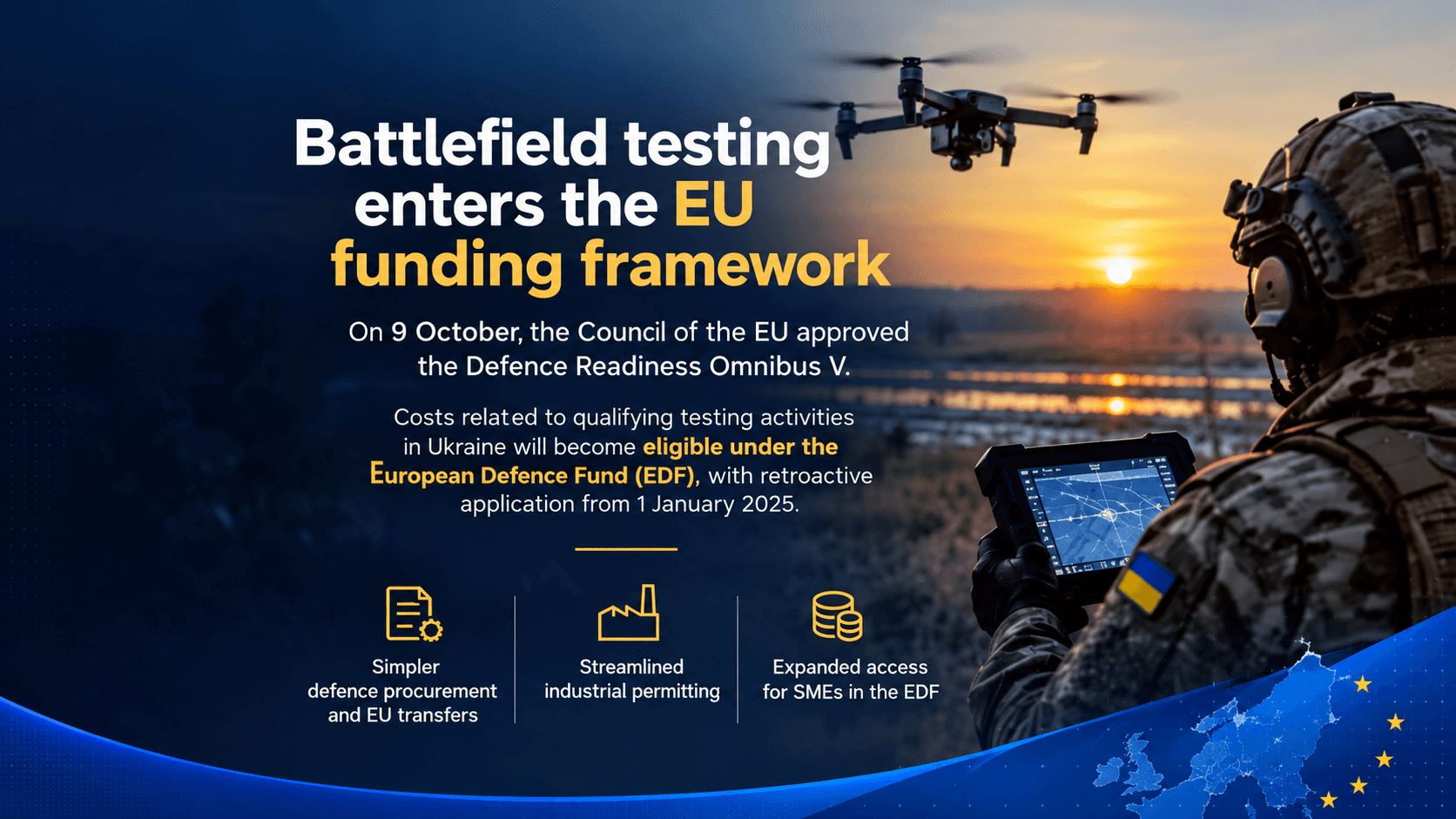
On 9 October 2026, the Council of the European Union gave its final approval to the Defence Readiness Omnibus V, a legislative package designed to simplify defence procurement, accelerate industrial investment and facilitate cross-border cooperation within Europe's defence sector.
The package consists of three legislative acts addressing defence-related industrial conditions, permitting procedures, procurement and intra-EU transfers of defence-related products.
It also introduces important changes to the European Defence Fund (EDF), including simplified administrative requirements and stronger support for small and medium-sized enterprises.
One development deserves particular attention: the explicit recognition of certain testing activities conducted in Ukraine as eligible expenditure within the EDF framework.
For European defence manufacturers, autonomous systems developers and research consortia, this creates a clearer legal basis for integrating Ukraine's operational testing capabilities into EU-funded defence innovation.
However, the legal consequences extend beyond funding.
Technology transfers, intellectual property, access to testing data, export-control authorisations and contractual arrangements must still be addressed separately.
The central question is therefore not simply whether European companies can test their technologies in Ukraine.
It is how such testing can be integrated into a legally compliant, financially eligible and commercially sustainable European defence project.
1. What changes under the European Defence Fund?
The European Defence Fund is established by Regulation (EU) 2021/697, which provides the legal framework for collaborative defence research and development supported by the European Union.
The Defence Readiness Omnibus introduces amendments intended to simplify the implementation of EDF projects and facilitate cooperation with Ukraine.
The adopted legislative text expressly addresses the use of Ukrainian testing capabilities.
Under the amended framework, certain costs connected with necessary testing activities in Ukraine may qualify for EDF funding where eligible project participants use infrastructure, facilities, assets or resources made available by Ukrainian organisations, subject to the applicable conditions.
The relevant amendment provides for retroactive application from 1 January 2025.
This is a significant development for technologies that benefit from validation under demanding operational conditions, including:
Unmanned aerial and ground systems.
Counter-UAS technologies and electronic warfare resilience.
Resilient navigation and GNSS-denied positioning.
Autonomous and AI-enabled defence systems.
Secure communications, sensors and system integration.
Ukraine's operational experience provides opportunities for rapid technical feedback that conventional testing environments may not fully reproduce.
The European Commission recognised this potential in its Defence Readiness Omnibus initiative, particularly the importance of operational validation and accelerated feedback for European defence innovation.
The legal significance is that qualifying testing activities in Ukraine can now be incorporated into a more explicit EDF funding structure.
This should not be interpreted as automatic reimbursement of all testing costs incurred in Ukraine.
Eligibility remains subject to the amended EDF Regulation, the applicable work programme, grant agreement, project budget and financial documentation requirements.
Retroactive application of a legislative provision does not, by itself, create an unconditional entitlement to reimbursement of previously incurred expenditure.
2. Ukraine's EDF association: an important legal distinction
Ukraine's position within European defence funding requires careful legal analysis.
In December 2025, the Council adopted measures enabling Ukraine's association with the European Defence Fund.
The European Commission subsequently confirmed Ukraine's full association with the EDF, creating opportunities for Ukrainian and European companies to participate together in collaborative defence research and development.
This development must be distinguished from the specific amendment concerning testing costs.
Three separate legal questions arise:
First, participation in EDF projects.
The eligibility of Ukrainian entities to participate as beneficiaries or other project participants must be assessed under the applicable EDF association arrangements, programme rules and call conditions.
Second, eligibility of testing expenditure.
The special provision concerning testing in Ukraine addresses the financial treatment of qualifying testing activities and the use of Ukrainian infrastructure and resources.
It does not replace the general rules governing eligible costs, procurement, subcontracting and grant implementation.
Third, technology transfers.
Ukraine's association with the EDF does not make it an EU Member State for the purposes of intra-EU defence transfer legislation.
Exports of controlled military products, software or technology from the EU to Ukraine remain subject to the applicable export-control framework.
EDF association, funding eligibility and export authorisation are legally distinct matters.
A project may satisfy one set of requirements without automatically satisfying the others.
3. Funding eligibility does not replace regulatory authorisation
A European defence consortium may have a valid basis for including Ukrainian testing activities in an EDF-funded project while still requiring separate authorisations for the transfer of equipment, software or technical information.
The relevant legal framework depends on the nature of the technology and the proposed transaction.
Military equipment and technology
Exports of military products from EU Member States are subject to applicable national licensing legislation, taking into account the framework established by Council Common Position 2008/944/CFSP.
Licensing assessments may consider the characteristics of the equipment, the intended end-user, the destination and the relevant security considerations.
Dual-use items and technologies
Where the equipment, software or technology falls within the scope of Regulation (EU) 2021/821, the EU dual-use export-control framework may apply.
The regulatory assessment may extend beyond physical products to controlled software, technical information and certain intangible transfers of technology.
Information security and contractual restrictions
Even where a transfer is not prohibited, access to sensitive technical information may be restricted by security requirements, grant conditions, confidentiality obligations or contractual arrangements.
For EDF projects, these considerations must be examined alongside the programme's specific security and eligibility requirements.
Consequently, a consortium should conduct a technology-specific regulatory assessment before transferring controlled equipment or information to a Ukrainian testing organisation.
4. Intra-EU technology transfers: simplification with limits
The Defence Readiness Omnibus also introduces changes to the framework governing transfers of defence-related products within the European Union.
Directive 2009/43/EC establishes the existing legal framework for simplifying the terms and conditions of intra-EU transfers of defence-related products.
The Omnibus reforms are intended to facilitate cooperation between European industrial partners, including through broader use of general transfer licences and arrangements relevant to structured industrial partnerships.
These developments may reduce administrative barriers for companies participating in cross-border European defence supply chains.
For example, a Dutch technology developer and a German systems integrator may benefit from simplified transfer procedures where the relevant legal conditions are satisfied.
However, a subsequent transfer of controlled technology to a Ukrainian testing partner must be assessed separately.
An intra-EU general transfer licence is not equivalent to an export authorisation for Ukraine.
Furthermore, the new mechanisms should not be treated as immediately available before the relevant legislation becomes applicable and, where required, is implemented through national law.
Companies should therefore distinguish between anticipated regulatory simplification and authorisations currently available under existing national licensing regimes.
5. Intellectual property: who owns the results of Ukrainian testing?
One of the most commercially significant questions concerns intellectual property and the legal treatment of testing results.
Consider a hypothetical EDF consortium developing a resilient navigation system for autonomous ground vehicles.
A Ukrainian testing organisation conducts operational validation and identifies weaknesses in the system's performance.
The feedback leads to modifications in software, algorithms or hardware configuration.
Several legal questions arise:
Who owns the raw testing data and technical reports?
Who has the right to use operational feedback for subsequent product development?
Do technical improvements qualify as results generated under the EDF project?
What rights does the Ukrainian testing organisation retain?
Can the consortium commercialise the resulting technology?
Are there restrictions on licensing or transferring the results to entities outside the relevant EDF framework?
These questions should be addressed before testing begins.
Article 23 of Regulation (EU) 2021/697 establishes important rules concerning ownership, control and transfer of results generated through EDF-funded activities.
In particular, restrictions may apply to certain transfers of ownership or the granting of licences involving entities in non-associated third countries, subject to the relevant legal conditions.
The contractual framework should distinguish between:
Background intellectual property: technology, software, designs and know-how developed before the project or independently of it.
Project results: outputs generated through activities covered by the EDF project, as defined by the applicable legal and contractual framework.
Testing data: measurements, observations, reports and other information produced during validation activities.
Access and exploitation rights: permissions granted to consortium members or testing partners to use particular information or technology.
Not all information generated during testing necessarily has the same legal status.
Ownership and access rights depend on the applicable law, the grant agreement, the consortium agreement and the specific testing contract.
Access to operational testing capabilities without a clear intellectual property and data-rights structure may create substantial commercial and regulatory risks.
For companies intending to integrate Ukrainian operational feedback into European manufacturing, these issues are particularly important.
6. Structuring cooperation with Ukrainian testing organisations
A legally robust testing arrangement should begin with the correct identification of the participating entities and their contractual roles.
Depending on the project structure, a Ukrainian organisation may participate as an eligible project beneficiary, subcontractor, service provider or another form of project partner permitted under the applicable rules.
These roles should not be treated as interchangeable.
The legal structure must reflect the actual activities performed, the allocation of responsibilities and the relevant EDF grant conditions.
A comprehensive testing agreement should address five principal areas.
1. Scope of testing
Define the technology, testing objectives, deliverables, performance criteria and required infrastructure.
2. Financial arrangements
Establish the basis for testing costs, supporting documentation, audit rights and compliance with the applicable EDF financial rules.
3. Intellectual property and data
Allocate ownership, access rights, confidentiality obligations and permitted uses of technical results and testing data.
4. Regulatory compliance
Identify applicable export-control authorisations, information-security requirements, sanctions considerations and restrictions on technology transfers.
5. Liability and operational responsibility
Allocate responsibility for equipment, personnel, loss or damage, confidentiality breaches, security incidents and other relevant operational risks.
The agreement should also address the treatment of sensitive information and any limitations on subsequent commercial use of the results.
For European consortia, early contractual structuring may reduce the risk of grant disputes, financial corrections and restrictions on later industrial exploitation.
7. From operational validation to European industrial integration
The broader significance of the Defence Readiness Omnibus extends beyond the reimbursement of testing costs.
It supports the development of a more integrated European defence innovation model:
European R&D → Ukrainian operational testing → Technical validation → European industrial integration → Procurement and deployment.
For companies developing autonomous systems, counter-drone technologies, resilient navigation and secure communications, this approach may improve technical validation and accelerate development cycles.
However, the transition from operational testing to commercial production requires more than technical success.
The consortium must determine whether the resulting technology can be lawfully manufactured, licensed, integrated and supplied within the relevant markets.
This may involve additional assessments concerning:
Export-control classification and authorisations.
Ownership and licensing of project results.
Security of technical information.
Industrial supply-chain arrangements.
Procurement eligibility and contractual obligations.
Applicable product, cybersecurity and sector-specific requirements.
The legal structure established during the testing phase can therefore have direct consequences for future manufacturing and commercial deployment.
8. Entry into force and transitional considerations
The Council's final approval of the Defence Readiness Omnibus on 9 October 2026 represents a major legislative milestone.
However, adoption and legal application must be distinguished.
As of 12 October 2026, publication of the new legislative acts in the Official Journal of the European Union remains pending.
The package provides for entry into force following publication, while certain provisions require subsequent national implementation or have specific application dates.
The amendment concerning eligible testing costs in Ukraine provides for retroactive application from 1 January 2025.
Nevertheless, companies should verify how that provision interacts with existing EDF grant agreements, project budgets and applicable financial rules.
Similarly, anticipated simplifications concerning intra-EU transfers and procurement should not be treated as already operational where national transposition or implementing measures remain necessary.
Until the relevant provisions become applicable, existing legal and regulatory requirements continue to govern the affected activities.
9. What should European defence companies do now?
For EDF consortia considering cooperation with Ukrainian testing organisations, the immediate priority is to determine whether the proposed arrangements are legally compliant, financially eligible and commercially viable.
An early legal review should address:
EDF eligibility: whether the proposed activities and expenditure satisfy the applicable funding conditions.
Partner structure: the legal role of the Ukrainian organisation and its relationship with consortium members.
Technology transfer: the classification of equipment, software and technical information, and any required authorisations.
Intellectual property: ownership, access rights, licensing and restrictions affecting project results.
Grant compliance: cost documentation, subcontracting requirements, reporting and auditability.
Industrial integration: the legal arrangements required for subsequent manufacturing, procurement and commercial exploitation.
These issues are particularly relevant for companies preparing future EDF proposals or entering grant preparation and consortium negotiations.
Addressing them before testing begins can reduce legal uncertainty and improve the prospects of translating operational results into commercially deployable technologies.
Conclusion: turning operational advantage into legally secure defence innovation
The Defence Readiness Omnibus V reflects an important evolution in European defence industrial policy.
Ukraine's role is increasingly recognised not only in relation to defence procurement and operational requirements, but also in the development, testing and validation of technologies relevant to Europe's defence industrial base.
The recognition of qualifying Ukrainian testing costs within the EDF framework provides an important legal and financial opportunity.
At the same time, the broader EDF association framework creates additional possibilities for cooperation between Ukrainian and European companies.
However, these opportunities do not eliminate the need for careful legal structuring.
Funding eligibility, export-control compliance, intellectual property, contractual responsibility and industrial integration remain distinct but interconnected legal workstreams.
The next competitive advantage will not come from access to testing alone. It will come from the ability to translate operational experience into legally secure, fundable and commercially deployable European defence technologies.
How CORVUS AI can support
CORVUS AI is a Netherlands-based legal and regulatory advisory firm working at the intersection of European law, defence innovation, autonomous systems and EU–Ukraine industrial cooperation.
Our Ukraine Testing & Technology Transfer Legal Review approach supports European defence companies and consortia in assessing:
EDF funding eligibility and project participation structures.
Contracts with Ukrainian testing and technology partners.
Intellectual property, technical data and exploitation rights.
Export-control and technology-transfer requirements.
Legal arrangements for European industrial integration.
The objective is to help organisations identify legal constraints early, structure defensible cooperation arrangements and move from technical opportunity to executable projects.
Disclaimer
This article has been prepared by CORVUS AI for general informational and educational purposes only. It is intended to make complex legal and regulatory developments easier to understand.
It does not constitute legal advice and does not create a professional adviser–client relationship. The information should not be relied upon as a substitute for advice based on the specific facts, circumstances and applicable law relevant to your organisation or project.
The article reflects our understanding of the law and regulatory framework as of the date of publication. Legislation, case law, regulatory guidance and administrative practice may subsequently change. While reasonable care has been taken in preparing this article, CORVUS AI does not warrant that the information is complete or remains current after the date of publication. We do not undertake to update this content.
To the fullest extent permitted by applicable law, CORVUS AI excludes liability for loss arising from reliance on this article. Nothing in this article constitutes an offer or solicitation to provide regulated legal services in any jurisdiction where doing so would be unlawful.
AI-assisted preparation: This article was prepared with the assistance of AI tools. Its legal analysis, conclusions and final text were subject to human review and editorial control and were reviewed and approved prior to publication by Oleksandr Sobovyi, Founder & CEO of CORVUS AI. CORVUS AI retains editorial responsibility for the published content.
For advice tailored to your organisation, project or specific circumstances, please contact CORVUS AI.
Complex law. Clear action.
Legal sources and further reading
Primary EU legislation and adopted texts
Council of the EU — Defence Readiness Omnibus V, final approval, 9 October 2026
Adopted Regulation — Defence readiness and facilitating defence investments, PE-CONS 45/26
Regulation (EU) 2021/697 establishing the European Defence Fund — particularly Articles 9 and 23.
Directive 2009/43/EC on intra-EU transfers of defence-related products
Regulation (EU) 2021/821 establishing the EU dual-use export-control framework
Council Common Position 2008/944/CFSP on the control of exports of military technology and equipment
Additional institutional sources
European Commission — Support to Ukraine and defence industrial cooperation
European Parliament — Legislative analysis of Defence Readiness Omnibus V
